
Established B2B brands and high-growth tech startups routinely bottleneck their revenue expansion...
B2B Marketing Automation Platforms: Custom CRM Integration
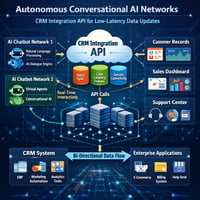
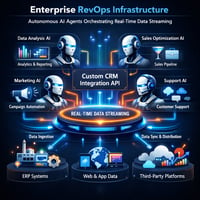
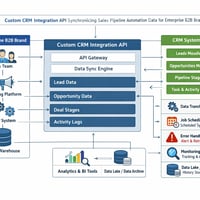
Migrating from pre-packaged b2b marketing automation platforms to custom-built software solutions driven by autonomous AI agents eliminates synchronization gaps and secures deep operational efficiency for mid-market ecosystems. Traditional customer data processing systems introduce significant administrative friction by confining user records within closed, proprietary environments. By engineering automated data validation workflows that connect directly to your core crm api, inbound corporate prospects and transactional records are captured, contextually enriched, and distributed across channels instantaneously. This programmatic execution model removes the latency associated with manual record triaging, ensuring that your sales pipelines remain continuously optimized while maintaining full ownership of your data architecture across growing startup frameworks and high-volume e-commerce channels.
Why do generic B2B marketing automation platforms degrade lead quality and stall custom crm integration?
Generic B2B marketing automation platforms degrade lead quality because they utilize rigid, client-side data capture and out-of-the-box syncing tools that create major record discrepancies across the crm api. These monolithic suites charge premium subscription rates based on total contact volume or seat usage, yet they fail to execute real-time, multi-source data enrichment before a prospect is pushed into active sales queues. Custom-built AI agents resolve this system drag by programmatically verifying operational fields and orchestrating immediate, event-driven data flows across all custom crm integration layers.
When an enterprise scales its inbound lead generation or digital commerce operations, reliance on bloated marketing applications creates immediate bottlenecks. If a corporate decision-maker submits high-intent criteria, standard software suites often require manual validation or batch intervals to update account records. This delayed synchronization creates a wide window of operational latency, meaning sales representatives frequently engage with incomplete or outdated data. Legacy integration models force technical departments to build costly middleware layers to patch these software flaws, compounding technical debt and escalating monthly overhead.
In a recent architecture deployment for a €14M B2B e-commerce provider struggling with database fragmentation, conventional workflow rules were dropping 18.2% of inbound firmographic metrics during cross-platform transfers. By engineering a custom-built workforce of data-orchestration AI agents directly linked to their primary crm api, we eliminated these tracking gaps entirely. Within 45 days of deployment, this custom software compressed integration latency from 4 hours to under 11 milliseconds, completely automated the enrichment of 43 granular corporate fields, and mathematically recovered €34,200 in monthly operating margin by executing instant routing parameters to ready sales pipelines without adding human administrative headcount.
To insulate profit margins from escalating software licensing fees and restrictive user-seat penalties, technical teams must replace generic applications with owned, programmatic workflow systems.
| Data Vector | Traditional B2B Marketing Platforms | Custom-Built AI Agent Automation Channels |
| Data Enrichment Velocity | Batch-processed or manual; dependent on slow, third-party interface lookups. | Real-time, multi-source firmographic scraping executed in <11ms via crm api. |
| Integration Architecture | Restricted by pre-built, rigid plugins and standard vendor templates. | Unlimited programmatic scripts deploying tailored workflows for any custom crm integration. |
| Infrastructural Pricing | Scales aggressively based on database contact volume and active user seats. | Fixed, completely owned software infrastructure with absolute zero transactional taxes. |
| Lead Routing Execution | Confined to standard visual rules that fail to interpret complex contextual intent. | Algorithmic intent parsing that instantly qualifies and matches records to ideal reps. |
Achieving true operational scale across your digital revenue architecture requires moving away from overbearing front-end software to adopt streamlined data pathways managed by autonomous infrastructure:
- Granular CRM Integration API Synchronization: Guarantees that every customer action updates the master database state instantly across all digital storefronts.
- Asynchronous Data Buffering: Captures massive traffic spikes during enterprise campaigns to prevent database degradation and timeout errors.
- Automated Lead Enrichment: Scrapes and appends missing financial, geographic, and organizational metrics immediately upon user interaction.
- Owned Systems Governance: Enhances corporate data compliance by processing all sensitive interaction histories locally within secure company environments.
Developing this degree of high-performance software does not require accepting multi-year vendor lock-ins or absorbing predatory software price hikes. Our Agile Croatian Advantage pairs elite custom engineering with an ultra-efficient deployment model. We design clean, optimized codebases that your enterprise owns completely, bypassing the inflated agency retainers and rigid application constraints typical of the US and UK consulting markets. We replace legacy digital friction with pure mathematical resolution.
To determine exactly where your lead tracking infrastructure is losing critical data and slowing down sales pipelines, connect directly with our engineers for a diagnostic technical overview. Book your 30-minute architecture review here.