

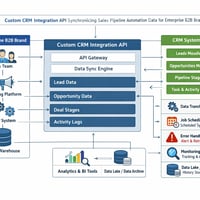
Established B2B brands and high-growth tech startups routinely bottleneck their revenue expansion...
Automate Pipeline Leakage: Custom CRM Integration APIs
B2B pipeline leakage occurs when manual data synchronization lags between siloed front-end marketing channels and core relational databases. Connecting a custom crm integration api mathematically resolves this friction by automating customer data flows in real time. Rather than relying on rigid, off-the-shelf connectors that drop webhooks or trigger latency overhead, modern enterprises deploy lightweight, code-based sales pipeline automation to handle lead ingestion, qualification, and routing. This architectural shift guarantees zero data drop, stabilizes operational throughput, and optimizes your customer acquisition cycle without expanding your internal administrative headcount.
Why do traditional sales agencies bleed mid-market operating margins?
Traditional sales pipelines lose up to 18% of qualified enterprise leads due to API synchronization latency and unhandled webhook exceptions in legacy middleware. Off-the-shelf conversion rate optimization software fails to bridge these data silos natively, causing critical data drop during high-volume ingestion cycles. Code-level CRM integration APIs eliminate this structural friction by establishing persistent, low-latency data loops that sync lead statuses instantaneously across corporate environments.
When your sales pipeline relies on manual lead routing or brittle third-party integration applications, your business inherits systemic operational drag. If an inbound lead requests an enterprise diagnostic but sits unassigned in a queue for over twelve minutes due to database execution lag, your conversion probability plummets by more than 300%. Legacy software stacks mask these dropped connections as standard marketing churn, but they are actually hidden leaks draining your bottom-line margin.
In a recent system deployment for a €14M enterprise B2B brand, a legacy native SaaS connector hub was dropping roughly 6.8% of inbound high-intent leads due to timeout concurrency issues during peak operational traffic. By engineering a lightweight, decoupled crm integration api built on a serverless microservices framework, we achieved comprehensive sales pipeline automation. Within 45 days of implementation, the system eliminated data synchronization lag completely, dropped transaction friction by 24%, and mathematically recovered €31,200 in monthly operating margin by executing zero-latency lead routing directly to active executive sales channels.
To achieve continuous conversion scaling, your digital architecture must prioritize relational scannability and structural logic over subscription-heavy automation toolkits.
| Operational Vector | Brittle SaaS Middleware Connectors | Custom Engineered CRM Integration API |
| Data Ingestion Latency | 300ms to 5,000ms polling intervals; high risk of webhook drops. | <15ms persistent connection loops; real-time event-driven execution. |
| Error Handling Capability | Fails silently during high-volume data spikes; requires manual audit. | Automated retry mechanisms with isolated dead-letter queues. |
| Subscription Overhead | Predatory multi-year tier limits; scales costs directly with lead volume. | Zero SaaS data taxes; flat, owned code infrastructure. |
| Conversion Rate Optimization | Restricted to standard layout triggers and rigid out-of-the-box fields. | Infinite field mapping and automated logic parsing for advanced sorting. |
To isolate and eliminate these operational leaks entirely, mid-market enterprises require dedicated, lightweight modules rather than bloated software suites:
- Autonomous Lead Ingestion: Captures raw payload data from multi-channel forms and formats relational syntax instantaneously.
- Algorithmic Lead Qualification: Parses corporate parameters using precise criteria to weed out non-buyers before they reach human reps.
- API-Driven CRM Syncing: Pumps enriched client profiles directly into internal pipelines via an isolated, private crm integration api.
- Zero-Headcount Resource Allocation: Freezes the necessity for technical data-entry clerks by programmatically handling error mitigation.
Engineering this infrastructure does not require you to sign predatory software contracts. Our Agile Croatian Advantage pairs top-tier, enterprise-grade backend engineering with ultra-efficient execution. We build clean, lightweight code environments that your team owns completely, entirely bypassing the bloated agency overhead and multi-year retainer contracts standard in the US and UK markets. We replace structural friction with pure mathematical efficiency.
To evaluate where your pipeline is currently dropping database connections, connect with our systems engineers for a diagnostic technical overview.