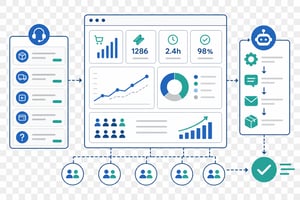


Scaling enterprise operations requires removing manual data-entry gates from post-purchase user...
Scale Support with Ecommerce Customer Support Automation
Quick Insights
- Post-purchase transactional inquiries like order modifications and tracking updates place a massive operational burden on enterprise support teams, driving up customer service costs.
- Relying on traditional seat-based or volume-tiered SaaS helpdesks creates a costly financial trap where every customer inquiry directly inflates software expenses.
- The solution requires implementing owned, server-side customer experience ecommerce software that directly connects to logistics pipelines to resolve tier-1 tickets instantly without human friction.
Why is post-purchase support overhead draining enterprise e-commerce margins?
For mid-market and enterprise e-commerce brands, the post-purchase phase is often the most cost-heavy part of the customer journey. After a transaction is completed, customer operations teams are typically flooded with low-complexity, repetitive inquiries. These are the classic "Where is my order?" (WISMO) tickets, address correction requests, order cancellation requests, and return status updates.
When a brand scales its sales volume, the sheer influx of these transactional questions creates an immediate operational bottleneck. If human customer service representatives must manually log into fulfillment networks, copy-paste tracking numbers, or manually alter order logs in separate management systems, your variable costs rise in direct proportion to your sales.
This manual intervention severely erodes gross product margins and prevents internal teams from dedicating their time to complex, high-value retention and commercial growth activities.
How do volume-based SaaS ticketing tiers create an operational financial trap?
To manage this growing influx of inbound tickets, customer experience leaders traditionally rely on legacy cloud helpdesks. However, these third-party platforms are built on pricing models that actively penalize a brand's commercial success. They charge either per user seat or based on the total volume of ticket interactions processed per month.
This creates a dangerous operational financial trap. If an external logistics delay occurs—such as a carrier backlog or a regional weather disruption—thousands of anxious buyers will naturally flood your customer support channels. Under a traditional SaaS model, this temporary ticket spike instantly pushes your business into a higher, much more expensive software pricing tier.
Furthermore, these customer service applications depend on heavy, front-end client-side chat widgets. Layering these external scripts onto your customer accounts page degrades mobile page performance, creates technical layout shifts, and breaks data continuity by keeping customer logs in isolated third-party databases.
How does customer experience ecommerce software resolve WISMO tickets securely?
Eliminating this recurring operational drain requires a fundamental technical shift away from front-end SaaS helpdesk plugins and toward owned, server-side customer experience ecommerce software architecture. By hosting your transactional support automation directly within your own cloud infrastructure perimeter, you maintain maximum data control and eliminate storefront rendering latency completely.
An owned, server-side conversational agent integrates directly with your internal systems, warehouse management platforms, and shipping carrier APIs. When a customer asks for an order update or needs to alter a shipping address before dispatch, the server-side architecture validates the customer's identity, retrieves real-time data from the logistics pipeline, and processes the request autonomously in milliseconds.
The transaction is updated, the customer receives an authoritative resolution, and the ticket is closed at the edge without a human agent ever touching the file. This architecture allows enterprise brands to achieve a highly efficient, predictable cost structure that preserves net margins while driving measurable customer lifetime value.
To see the direct comparison between traditional seat-based helpdesk software and owned server-side conversational infrastructure, review the operational metrics below:
Stop treating post-purchase support as a linear headcount problem that drains your bottom line. It is time to transition to a high-performance digital architecture built to protect your enterprise margins.
To learn how your brand can structurally automate post-purchase operations and secure your data infrastructure, click here to book your strategic infrastructure assessment and deploy advanced ecommerce customer support automation.